
The stock of Godrej Consumer Products Limited (GCPL) fell about 3.7 per cent in trade after its Q3FY24 earnings disappointed brokerages and led to downgrades. Further, the stock, after a 15 per cent run-up over the past month prior to Monday's correction, had already factored in the upside from the business front. Its peer in the consumer space, Marico, too, saw a 4 per cent drop in its stock price.

Oil firms were supposed to break-even on sale of petrol, diesel, LPG and kerosene if the price of the basket of crude India buys were to come down to $67 per barrel. However, with 20 per cent depreciation in value of rupee against the dollar, the break-even point is now at $61 a barrel.

India imports 1.2 billion barrels of oil, and oil prices are falling, falling...

Benchmark indices ended the day in the negative territory on Tuesday amid weak global market trends and rising crude prices. Falling for the third day running, the 30-share BSE benchmark ended 208.24 points or 0.33 per cent lower at 62,626.36. During the day, it tumbled 444.53 points or 0.70 per cent to 62,390.07.

Will the rupee keep falling in value against the US dollar? What will be its impact?

The faster-than-expected rise in interest rates by the US Federal Reserve (US Fed) shook global financial markets in early 2022. And now the ongoing war between Russia and Ukraine has lifted commodity prices, with Brent crude oil hitting a 14-year high of $139 a barrel in intraday trade. All these developments have sent the equity markets across the world into a tailspin.

A sharp rally in domestic stocks from June lows has once again rendered Indian markets expensive to their emerging-market (EM) peers. The 12-month forward price-to-earnings (P/E) multiple for the Nifty50 Index is around 20.6x - 82 per cent higher than 11.3 per cent for the MSCI EM Index. India's valuation premium has hit a five-month high. This is on the back of sharp outperformance to EM and global peers from June lows and also due to earnings downgrades, following the April-June quarter of 2022-23 earnings.

India's macroeconomic indicators are improving and inflation has been coming down consistent with the central bank's forecast, but Asia's third-largest economy needs investment growth to pick up, he added.
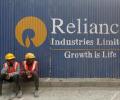
Reliance Industries Ltd on Friday reported a 9 per cent rise in its December quarter net profit as a planned maintenance-induced weakness in oil business earnings was offset by stability in retail and telecom verticals. The oil-to-retail-to-telecom conglomerate's consolidated net profit of Rs 17,265 crore, or Rs 25.52 per share, in October-December - the third quarter of the current 2023-24 fiscal - was 9.3 per cent higher than Rs 15,792 crore, or Rs 23.19 a share, earning a year back, according to a company statement. Quarter-on-quarter, the profit was lower when compared to Rs 17,394 crore earnings in the preceding three months ended September 30.

Petrol price was on Friday cut by Rs 2.42 per litre and diesel by Rs 2.25 a litre after an excise duty hike limited the benefit of global crude prices slumping to six-year low.

Petrol and diesel prices on Tuesday touched fresh highs as rupee dipped to a record low of 71.54 against US dollar, making imports costlier

eclined for the third month in a row in January, falling by 2.38 per cent year-on-year to $36.43 billion, while the trade deficit widened to $22.99 billion in the month. Imports rose by 10.28 per cent year-on-year to $59.42 billion in January due to an increase gold shipments, according to the Commerce Ministry data. The trade deficit was $21.94 billion in December and $16.55 billion in January last year.

'In staples, we have still managed in rural areas.'

Oil India is set to usher in a new era with a road map drawn to ramp up production and diversification plans to foray into liquefied natural gas

Indian equity markets should be able to withstand inflation up to 8 per cent, said analysts at Credit Suisse Wealth Management in a recent note. Should the rate of inflation move higher than this, the valuation of Indian equities could deteriorate further, they cautioned. The fall from the peak levels has seen Nifty's 12-month forward price-to-earnings (P/E) ratio of 17.6 dip toward its 10-year and 5-year (pre-COVID) average of 16.9, which suggests that valuation froth of Indian equities has settled, said the Credit Suisse analysts.

The Islamic State rakes in over US $1 million (Rs 6.4 crore) per day in extortion and taxation and the dreaded terror group has enough assets to cover its expenses despite falling oil prices, according to a media report.
The local currency moved in a range of 59.80 and 60.05 per dollar during the morning trade.

Slide in the rupee, surging oil prices, and rising bond yields have triggered the latest fall in the market.

India and the US are likely to agree on an interim trade agreement before July 8 with New Delhi pushing for full exemption from the 26 per cent reciprocal tariff on domestic goods, an official said. The US on April 2 imposed an additional 26 per cent reciprocal tariff on Indian goods but suspended it for 90 days till July 9.

The inflow of cheap capital has also kept the rupee at a high level, making exports uncompetitive and broadening the current account deficit despite falling oil prices.

While consumers have enjoyed lower fuel prices, producers have cut spending and thousands of jobs

Wholesale inflation rate eased to 34-month low of (-) 0.92 per cent in April on easing prices of food, fuel and manufactured items. The wholesale price index (WPI) based inflation has been on a declining trend for 11 months in a row and entered the negative zone in April. In June 2020 WPI was at (-) 1.81 per cent.

Weak equity markets too hit rupee sentiment

Benchmark equity indices Sensex and Nifty reversed their early gains to close lower on Wednesday due to selling in oil & gas, banking and IT stocks amid weak trends in European markets. The 30-share BSE Sensex declined by 372.46 points or 0.69 per cent to close at 53,514.15, extending its falling streak to a third day. The index opened higher and touched the day's high of 54,211.22 amid gains in Asian markets.

The domestic currency had gained by 80 paise, or 1.19 per cent, in previous five trading days.

Wall Street brokerage Bank of America Securities has pencilled in lower than the consensus retail inflation for the current fiscal year at 5 per cent, but higher than the previous forecast of 4.7 per cent. Stating that the June print will be critical for the future trajectory -- after the extremely high 6.3 per cent print in May, the brokerage in a report on Friday revised upwards its forecast by 30 bps to an yearly average of 5 per cent for the year to March 2022. "Though the June print will be critical for future trajectory, beyond near-term, we find some comfort from our analysis of four key factors that are likely to influence CPI inflation the most.

Many individual states experienced higher inflation than the all-India figures during the financial year 2023-24 (FY24). Retail inflation figures in Telangana, Haryana, Rajasthan and Dadra and Nagar Haveli have been higher than national numbers every month of this financial year, shows a Business Standard analysis of state-wise figures, after the March inflation data was released on Friday. Experts noted that persistent high food inflation along with differences in the weights of rural and urban indices plays into the regional variation in inflation rates.

Industrial production and inflation data, quarterly earnings from IT majors and global trends would drive the equity markets in a holiday-shortened week, analysts said. Moreover, foreign fund trading activity, movement of the rupee and global crude oil prices would also dictate terms in the market, they added. Equity markets would remain closed on Friday for 'Dr Baba Saheb Ambedkar Jayanti'.

Market participants attribute the stability to the Reserve Bank of India's timely intervention in the foreign exchange market, both in terms of selling and buying dollars.

Benchmark indices settled lower on Friday, with the Sensex declining 111 points on the back of a sharp fall in index heavyweight Reliance Industries. The BSE benchmark went lower by 111.01 points or 0.21 per cent to settle at 52,907.93. During the day, it tanked 924.69 points or 1.74 per cent to 52,094.25. The NSE Nifty dipped 28.20 points or 0.18 per cent to close at 15,752.05.

Irregular rainfall and a pick-up in commodity costs are expected to weigh on the demand and margins of fast-moving consumer goods (FMCG) companies. Most companies reported a sharp expansion in gross margins in the April-June quarter (first quarter, or Q1) of 2023-24 (FY24), given the lower prices of key raw materials and earlier price hikes. Furthermore, there were expectations that cost savings being passed on could reflect in volume growth going forward. However, these hopes could be dashed if demand recovery, especially in the rural segment, stalls, and gains on the raw material front start to recede.

A fall in the rupee could boost exports. But the flip side of the equation is that a weaker rupee could stoke some inflation

ATF for domestic carriers has become 11.22 per cent cheaper since October and is expected to see more price cuts in the next three months.

'Focus on 19,400/64,900 as the key resistance levels for the Nifty/Sensex.'

Among the Sensex firms, UltraTech Cement, Reliance Industries, ICICI Bank, HDFC Bank, Bharti Airtel, IndusInd Bank, State Bank of India, Tata Consultancy Services, Larsen & Toubro, Kotak Mahindra Bank and State Bank of India were the major gainers. In contrast, Tata Motors, Maruti, Axis Bank, Mahindra & Mahindra, ITC, NTPC, Tata Steel and Bajaj Finserv were the major laggards.

The loss, which is made good through government subsidy, has declined since March as the rupee strengthened against the dollar and global oil prices softened.

Among top losers that dragged down key indices were Infosys, TCS, Reliance, SBI, Tata Steel and ITC, falling up to 2.15 per cent.

The broader markets also ended in the red, after a rally seen in the sectors last week.

'If weak indicators persist, there is a risk that India could slip into a prolonged slowdown similar to the one experienced between 2014 and 2019,' warns Debashis Basu.

Among the Sensex firms, Infosys, Bharti Airtel, NTPC, Tata Motors, IndusInd Bank, Bajaj Finance, ICICI Bank, Tech Mahindra, Titan and Axis Bank were among the major laggards. Tata Steel, State Bank of India, Mahindra & Mahindra, Maruti and Nestle were the gainers.
